Thursday, 12 January 2012

Palmerston North - GHG's

After meetings with six different scientist I have certainly learnt a lot about greenhouse gas emissions in Palmerston North.                            As New Zealand is such a green country, agriculture and in particular ruminants are responsible for a large amount of the greenhouse gas emissions in NZ and this is the reason why so much research is being carried out here. They all felt strongly that many things that had been suggested, are not as good as they are sometimes made out to be and have not always worked when they tested it in the chambers. They may work on the laboratory level but they need to get it to work on the animal level. There are three main ways of testing it on an animals level, FS6, greenfix and the chambers. They found that FS-6 is quite variable and not replicated in chambers. Chambers are more accurate. Since they first installed the chambers they have compared lambs and ewes, grass quality, lactating ewes, cattle and sheep, beef and dairy cattle and done some alpaca work. The greenfield system is more accurate than PS2 but there are issues with some animals going in more regularly than others and concentrates are not used that much in NZ. 
They feel the four challenges are manipulating rumen function, reducing nitrous oxide emissions from soil, manipulating the rates of soil carbon change and creating tools for farmers decision making. The six key objectives are:
1.Rumen microbial ecology and rumen microbial strategies to reduce methane emissions
2. Methanogen genomics
3. Methanogen vaccines
4. Exploiting animal to animal variation
5. Low GHG emitting farm systems
6. Nitrous Oxide Mitigation
The main area of research and progress has been with nitrous oxide. Applying DCD can reduce nitrous oxide by 70%. The problem is breaks down at 12 degrees celcius. The next biggest break through has been finding low and high emitting ewes. These have been mated with low and high emitting rams and they are investigating this further with the offspring. There is 9-40% difference in animals. However heritability has a low value.

They have also found variation in pasture (high sugar grass and brassicas lower emissions). One trial showed that brassicas reduce emissions by 20%.
They are working on vaccines and inhibitory compounds to raise antibodies in animals against the gut bacteria that produces the methane. The question is is this successful how much will the vaccine cost and will it be worthwhile. Carbon trading is also a reason for research in this area and a lot of decisions remain to be made. It is likely that the processors will be the point of obligation e.g. milk factory, meat processor etc rather than the 40,000 farmers. This will reduce it to around 300 points of obligation and average it out across the farmers. It may be possible for farms to claim they are better than average but then this creates a lot of work to prove it. Improving intensity may reduce liability. There is now becoming more of a focus on emission intensity. Emission intensity has been reduced in the sheep sector by over 20% as they have 20 million less sheep but the same amount of lamb produced. However intensification and dairying has increased Nitrous Oxide emissions.

Monday, 9 January 2012

Farm visit - Featherstone

This farm visit focused around breeding as they sell over a thousand rams each year to 150-160 clients. In the 80's they averaged 14 rams per client but as people have increased fertility in their flocks people are purchasing less Romneys and more terminal sires. People also now have a higher ewe to ram ratio. All rams are sold on farm. About half of them go to the South Island, of which many go to the Gore area. They have 4,600 ewes fully recorded to 70 different sires. These are all recorded electronically. They said it was costly but it has saved a lot of man hours. They have two electronic weighers and automatic shedders that divide up to five different ways. The ewes are set-stocked for lambing. They said that tagging at birth can be a difficult job. 730 lambs were tagged one day last year. The lambs are docked at 160%. They also keep 15% more two tooth's than they require to have a good bunch to select from and then the surplus are sold on farm. They feel that this year is the best for twenty to thirty years considering the good spring they have had and the price of the animals. New season lamb is currently $7.40 per kg compared to $6.11 in January 2011 and $4.58 in January 2010. They are predicting that hoggets may sell for $250 this year (£125). Old ewes are currently worth $4.50-$5 at the works and ewes going through market are making $150+ (£75+)
We discussed their breeding policy and how they have been involved in developing the gene marker for Footrot resistance and facial eczema. However, their selection emphasis is on three key priorities, early growth rate, lamb survival and internal parasites.
We also discussed shearing and the best time to shear the rams so that they have about two inches of wool when they are sold, to have wool long enough to see what the wool is like, but short enough to see what the animal looks like. Barbar's pole worm and facial eczema seems to be less of a problem the further south I go. Facial eczema may occur once every ten years on this farm.
300ha of the farm is irrigated. This is the area that most of the crops are grown and lambs are finished.  One fifth of this is put into Chicory each year. The irrigated paddocks are split into 3.5-4ha.
They also buy in steers, currently on the farm there are 400 two year olds nearly finished and a further 400 to finish next summer. They know there is not much money in doing this but know they are good for pasture management and worm control, and again this is the main reason for cattle on the farm.

Masterton Farm Visits

The first farm I visited in Masterton feels that EID is central to the operation's decision making and allowing them to farm with maximum efficiency. The farm carries 10,000 stock units. 6,300 ewes scanning at 194%. All lambs are finished on the property. Ewe lambs are sent away and come back as 2 tooths. Some ewes are also on other farms and he pays people to look after them on a per head basis, but he goes to do the major jobs.  He also runs 240 Angus breeding cows, mated to Angus bulls, These are also finished on farm from 18-24 months. The cattle are predominantly there to support the sheep policy. All animals are EID tagged. Information such as singles, twins, triplets, mothers age, sire breed, drench/health records, weights and yields from abattoir are all recorded on the system. The main thing he uses it for is to compare weight on lambs that have received different treatments under the same environmental conditions, for example some lambs are given B12 and some left without to compare. He has also compared lambs on different pasture and lambs on crops were 3kg heavier than those on grass. He has also found that lambs grow better on some crops, however the yield is better from other crops. This has made him change the system to move the lambs onto certain crops just for the last couple of weeks to get better yields after they have been on the crops to improve growth rate. The automatic drafter is used at weaning to draft three ways depending on daily liveweight gain. If its growing well on grass he doesn't see any point on moving it on to more expensive crops. The automatic drafter was doing 500 per hr, however he has added more to the selection criteria and its now only doing 350 per hour this year. The lambs are weighed 10 days after putting them on crops to check they are improving, if  they aren't doing well, theyare put on a different feed. EID is used to select replacements; selceting multiples, and those with good DLWG. 3000 are sent to another grazer soon after weaning and underperforming ones are taken out. He thinks EID is the best tool on the farm for calculating, measuring and analysing data and ultimately informing financial policy changes. 

The focus of the second farm I visited is Ram breeding. They are part of an improvement group that sells the majority of the Romney rams. This farm runs 2000 romney ewes, of which 800 are fully recorded. The scanning percentage has been around 170% for a number of years. They winter around 300 recorded ram  lams and sell around 100 rams each year. They said they really need to sell more rams to be viable and worthwhile recording. All lambs are tagged at birth and remarks are noted such as bad maternal instinct, small, dead, weak etc which would would make them not considered for future breeding. The next record taken is the weaning weight, then the eight month weight and the fleece weight at shearing. A percentage is taken out at weaning if they have low DLWG, wool is marked, daggs etc. No lambs are kept from ewes that don't catch in the first cycle. Rams are sold in November at 13/14 months to use in March/April. Some are also leased out in February. All rams are sold on farm on a one to one basis. They also sell females for further breeding. Facial eczema is less of an issue here than further north, however it is still considered in their breeding and they have purchased a ram that has good values for this. They also winter over 100 cattle, 57 breeding cows and the rest are finishing animals. The cows are Angus cross Hereford and an Angus bull is used. The farm is usually summer safe however a couple of years ago they sold all the cattle due to the drought and only last year purchased cattle again. The cattle were sold to save the sheep. Again cattle are not that important to the farm.

Saturday, 7 January 2012

Abattoir visit - Hawke's Bay

The scale and efficiency of this abattoir was very impressive, slaughtering 12,000 a day. 10 per minute. They have 2 lines and each line slaughters 4,000 in the morning shift and then the evening shift starts at 4pm through to 11.30 when only 1 line runs. This is only a lamb and mutton abattoir and sometimes veal. It was interesting to compare this abattoir with the one I visited in Australia. I felt this one in NZ is more similar to the UK than the Australian abattoir. The security was very strict and they required identification of who I am and what I do before they would show me around. No dogs are allowed in the lairage, lambs can arrive anything up to an hour before they are slaughtered, especially at the moment when they are short of lambs. Due to it being a good growing season and plenty of grass around many farmers are holding on to the lambs to get them heavier. The animals are all slaughtered according to Halal with a lot of meat being exported to the Middle East. 90% of the meet is exported to many countries around the world. There was very little wastage. Some livers are condemned due to facial eczema, liver fluke or c. tenicolis. These are all sent to be made into dog food. Most carcass weights were between 16.5kg-19.5kg at this abattoir today. There were some 22kg but these were over fat and the farmer is penalised for this, unlike in Australia. Some carcasses are exported whole, however the majority go to the boning room. As the carcasses go into the boning room they go through a X-ray machine that calculates where to cut them into the three sections to get the best value for the carcass. The yield of each third is fed back to the farmer. This allowes the farmer to see what area he needs to focus his breeding on.

Farm visit - Waikukurau


Romney rams
The farm I visited in Waikukurau is run as part of her father’s farm and her brothers farm and they have another farm and ground to finish lambs on nearer Hastings. Just on this farm there are 3,900 Romney ewes and 210 cows. Her father purchased this farm in the 90’s to expand his system. He has a Romney and Parendale stud. It was interesting to hear about their breeding system and how 500 two tooth ewes are sold annually for further breeding in a sale early in January. Looking at the animals on this farm they all looked very strong and uniform.
Angus Bull with Angus cross Hereford cows and calves
She also uses some Suffolk and South down rams. The cattle on the farm are Hereford cross Angus calving in November. The cattle are kept for grassland management purposes and are always mixed in paddocks with lambs or hoggets, preferably not ewes as ewes keep the paddocks reasonably good, grazing shorter than lambs. This farm only shears the ewes annually and this does cause some problems with ewes getting stuck on their back at lambing time, but they don't feel it is cost effective to shear them more often. The farm is farmed extensively and is set stocked. They have not put fertiliser down for a few years as things have not been very good. However thing have improved financially and they will probably apply fertiliser this year. We discussed the regulations they are under and she said that they are increasing quickly and thinks it will be similar to the UK within 10years.

Thursday, 5 January 2012

Wool shed - tourist attraction

As NZ has an extended holiday over new year it has been difficult to get visits arranged for this week. I thought that this would not affect farmers, however even farmers take holidays over here! If they are not on holiday they are really busy weaning. Therefore I decided to do some tourist things and found an old woolshed with original, 100 + year old farm/wool equipment which explained the history of wool and sheep in NZ very well. The owner was also very helpful and he answered a lot of my questions. I felt that I learnt a lot about the sheep industry in NZ and how its got to where it is today with the various breeds. However Romney's are still the dominant breed in NZ by a long way.  There is great detail in this wool shed on how the wool is sorted. Wool is not sorted to the same extent as it used to be, but it is still sorted and bales labeled CRT (Crutching), LBS (lambs wool), E/S (Ewe’s wool), NKS (Neck wool), B/S (Belly wool), 2/S (second shear). We discussed frequency of shearing and he said most shear ewes every 8 months and lambs at 5 months. We also discussed sheep diseases and in particular facial eczema.
He also had a pet possum which led to discussing the problems they cause. He said the biggest problem is they carry TB and damage trees. This was definitely the most interesting informative shed I have been in and a great way of educating the general public and the displays were fascinating from various shearing equipment to pictures of old saleyards, various wool types, wool insulation, posters of the beef and lamb cuts and information on farms in the area. As well as a range of animals, various sheep breeds, pigs, sheep dog and a possum.  

Hawke's Bay

After seeing the New year in at Taupo I headed over to Hawke's Bay. The first meeting I had in this area was with a company that is now nearly as active in the UK as it is in NZ. However the nucleus and multiplier flocks are on a much larger scale in NZ (10X) to reflect the farm sizes in each country and the NZ flocks were developed a few years before the UK flocks. The main reason they are working in the UK is to try and get a year round supply of lamb. NZ lambs from June (some in Hawke’s Bay area) through to October (in the South). However, most lamb in September with most lambs sold between December and April.
The focus of the maternal breeding programme combines fertility and survival rates to deliver an efficient and profitable ewe system. The targeted breeding objectives are; lamb as a hogget, rear two as a two tooth and onwards, longevity (lambs over lifetime/liveweight), efficiently wean their body weight plus, all of these contribute to a more efficient sheep system. The focus of the terminal breeding programme is designed to provide high performance finishing lambs which excel in meat characteristics. These include; to lamb unassisted, fast growth and early maturity, efficient conversion of grass to carcass and selection for market required meat characteristics. Many of these are essential in reducing Greenhouse gas emissions from the flock e.g. lamb them as hoggets, number of lambs (fertility), ewe liveweight, longevity, efficient conversion of grass to carcass.
The flocks are recorded and DNA pedigree tests are used to get the parentage at marking when they are also EID tagged. EID has been used on some of these farms for 12years. Dock weight, weaning weight, post weaning weight etc is all recorded. All nucleus flock lambs are weighed at birth and aim for 5kg birth weight.
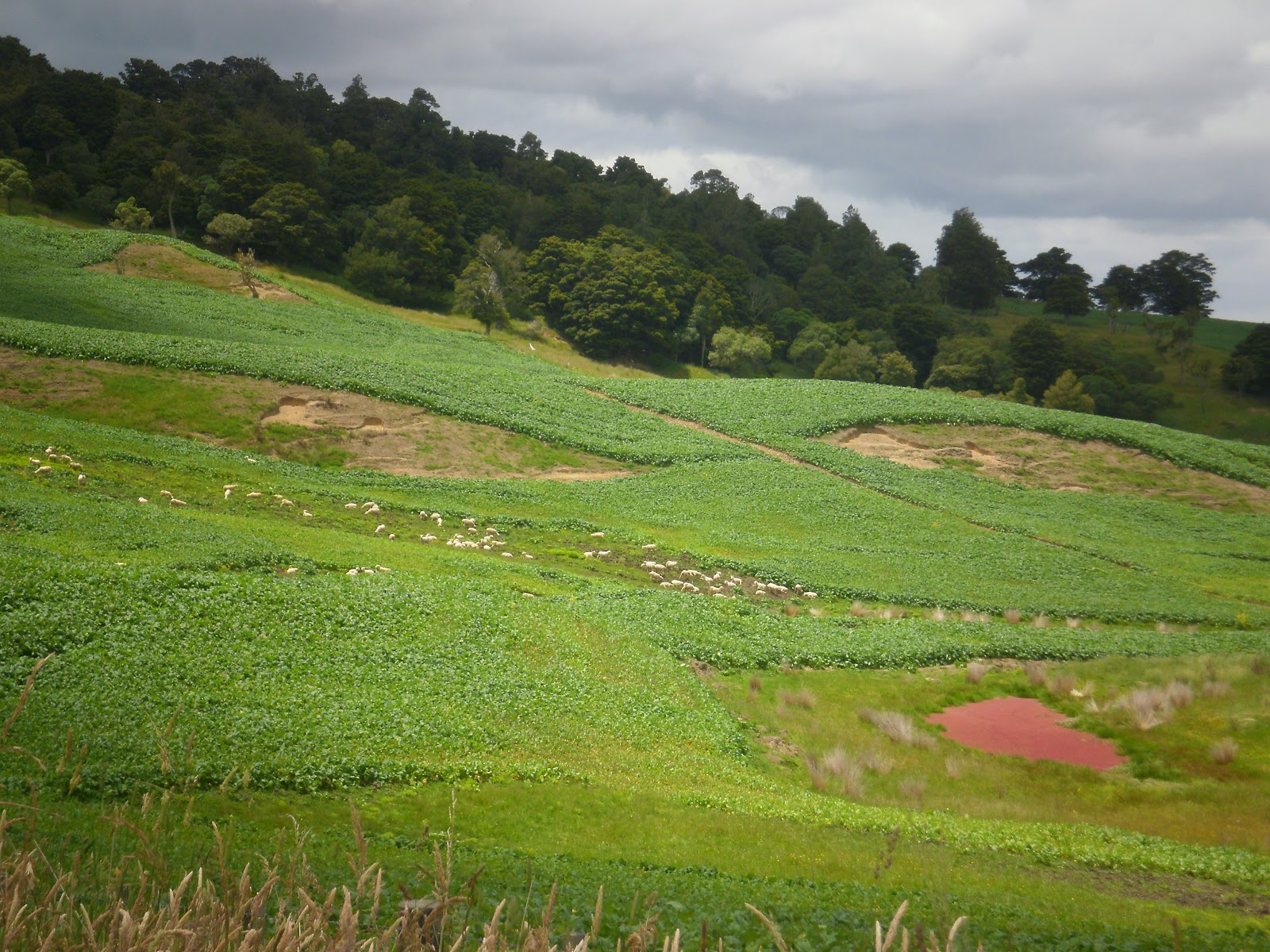
We discussed feed conversion rates and this is an area they would like to look into and conversion efficiency is next on the agenda. They have carried out trials on improving efficiency of the rumen e.g. vitamin to reduce stress at weaning and different weaning treatments e.g. early weaning to develop rumen. They have also carried out many eating quality trials to see the variation in the breed and have worked with organisations on developing the meat quality DNA marker. This is all considered in the ram selection. They have also looked at meat eating quality and taste on five different forages including high sugar grass, lucerne, chicory and brassicas. It is obvious from driving around that brasicas are used widely to finish lambs and I have been surprised by the landscape that they are planted on.