Wednesday, 25 January 2012

Farm visits Ashburton

The first farm I visited consisted of 30,000 stock units made up with deer (around 5,000), sheep (12,000) and cattle (600). They have very different weather here to just a little further south and the landscape appears very green. They did say this is the best growing season they have had and they are still restructuring the flock  after the drought in 2009/2010. They culled a lot of hoggets that year. The ewes are mostly Coopworth ewes scanning at 170%. They are tupped in April/May and moved regularly through tupping up to June. Then they are moved onto swedes and kale up to 6 weeks before lambing. Singles may stay on brassicas up to 1 weeks before lambing. The multiples are set stocked for lambing at 9-12 ewes per hectare. Singles are not set stocked, at lambing they are then shed off daily. This gives them the option to move them depending on weather and grass availability. This year they have also purchased some store lambs (1,500) in late December/early January to control the grass.
The deer herd consists of 3,500 english red hinds, 1,400 stags and 30-50 sires. There are 300-500 in the velvet herd. Half the hinds are put to an elk cross as they finish better. The deer fawn November/December on high ground and are sold between 10-18 months. Some may go at 8 months. 
Cattle mostly consists of dry dairy animals or store cattle. Both cattle and sheep graze deer paddocks. Deer are browsers and both cattle and sheep are used to control grass/clean up the paddock. I was surprised to see dogs being used to move the deer.
They make silage (grass silage and oats and peas) to feed all animals over the winter. The deer get the better quality oats and peas. Swedes and kale is also grown for all species. Sometimes they will have 800 hinds on brassica crops.

Tuesday, 24 January 2012

A visit to a fine wool flock

Driving up through the centre of the South Island I was amazed how dry it is and the transformation of land with irrigation made dairy farming possible in large parts of this area. However the farm I visited decided not to irrigate due to the cost. The farm I visited is 18,500 ha ranging from 500 to 2000 metres above sea level. Merinos are the only animals on the farm. There are 14,000 ewes, 8,000 hoggets, and 1,000 rams with a mean fibre diameter of 12.5 microns producing 80 tons of wool. The breeding programme has been in place for 30 years and has enabled them to screen 200,000 sheep for diameter, fleece weight and quality. All sheep in the flock are objectively measured for micron and clean fleece weight. Prior to shearing, micron and yield are measured by mid-side sampling of all animals as hogget’s. At shearing these results are used for classing the wool into lines of pre selected micron ranges (using the 9 way auto drafter). Fleeces are also weighed at this time to allow assessment to select superior animals. As well as using objectively measured data, these sheep undergo a rigorous visual assessment for structural soundness and wool quality prior to qualifying for the Elite and commercial flocks. The Elite Flock is used for breeding the stud rams that continue the unique process of producing superior ultra fine fibres. Rams are sold as four tooths to their client base at the annual auction in early January. The flock objectives are to produce maximum quantities and superior quality ultra fine Merino wool by reducing fibre diameter (micron), increasing clean fleece weight, reducing CV to reduce variability within the fleece and within the flock, producing and maintaining structurally sound and healthy animals, producing quality fibre.  The merinos lamb in October, then the lambs are marked end November/early December. They are currently being weaned and then they are shearing next week and they will go out to the high country. At tupping time (10th May) they come back down to the low country and are weekly moved. Most ewes cut a 4kg fleece. 3.7kg is the average fleece weight including the hoggets. What amused me most about the merinos is their social behaviour. Often seen in groups, lines or even circles. Helicopters are used for mustering sheep and most farm tasks on this farm.

Sunday, 22 January 2012

A day at a Perendale and Cheviot stud farm

This 450 hectare farm is predominately a perendale flock (4,000 ewes) with a perendale stud and a cheviot stud and some finishing cattle also on the farm.
The Perendale stud is 550 ewes selling around 150 rams each year (just under half the male lambs). The Cheviot stud is just over 200 ewes selling around 75 rams each year. Rams are sold privately on farm with a few of the top performing rams sold at the Gore ram sale. The commercial Perendale Flock is put to the top ram hoggets from the stud every year and generally 500 + surplus ewe lambs are sold each year.
The ewe's lamb in September (155%) and the ewe lambs a few weeks later. They feel lambing ewe lambs is an essential tool for farm profitability and identifying top performers within the stud. They are set stocked for lambing. and no assistance is given. The stud flocks are tagged at marking to identify sire. At weaning (between Christmas and new year) the lambs are given a drench but not sorted. They are bought in a few weeks later and sorted according to sex and small and large ones are taken out. Lambs will be shorn in 3-4 weeks. Ewes are shorn every 6 months. They plant about 60ha of forage crops (Swedes and kale every year). However this year they have only planted 30ha so far as its been so dry and the crop is not establishing very well. The lack of rain is currently a big issue and worry in this area as its probably the driest its been for over 10 years.


Saturday, 21 January 2012

Perendale and Cheviot ram sale and Perendale field day

Perendale

Experiencing a ram sale in NZ is a little different to one in Wales. Most rams are sold on farm and only the top performing rams go to this sale. They have to be in the top 20% and have a minimum fertility potential of 160%. All rams are individually penned at saleyard. Individual details were stapled on each pen, which included sire, dam and sire and dams, sire and dam, date of birth, 100 day weight, 200 day weight, fleece weight, single or twin (birth & rear rank), carcass measurements and any further comments such as CT scanned and FEC. The veterinary certificate is also shown on all pens. A vet has to check for testicular anomalies, under sized testicles, sheath abnormalities, mange, scrotal abscesses, lameness etc. There is also a panel from the society that goes round and checks them all the day before that they are true to type, sound on their feet etc. Each stud has one vote for the best ram in the Perendales. The perendale is a cross 
Cheviot
between a cheviot and romney and is now recognised as an official breed for over 50 years.Both the cheviots and the perendales had good sales mainly due to the fact that there were some Australians over purchasing quite a few.
After the sale I went to the perendale progeny test field day where they had lambs to view from each of the 9 sires used. The North island also carries out progeny testing and they use a link ram between the two groups. All lambs will be killed on the same day towards the end of February. As all lambs go the same day to get progeny information the abattoir agree not to penalise for over weight or over fat lambs as they realise the importance of the trial. Ultrasound scanning, CT scanning, viascan, pH fat colour all have a huge variation from top to bottom sire. They are also tested for taste and tenderness. Lambs from high performing ewes are 25 days quicker finishing. They aim to get the information to breeders before mating.  They have a selection committee of 5 people (1 independent and the rest perendale society members) to select the 9 best performing sires to test in the trial.

Friday, 20 January 2012

Meat processor meetings

As meat processors are predicted to be responsible for only 3% of the lamb carbon footprint I was very impressed by everything this processor is doing to reduce the lamb carbon footprint. But I guess as it has one of the largest plants in the world (slaughtering 32,000 lambs a day at peak season) some might say it should be leading the way. It has introduced many processing energy efficient programmes and alternative energy projects in the plant as well as encouraging on farm production efficiencies. This includes Viascan for yield grading assisting with on farm management decisions. There is an yield bonus on a per lamb qualifying basis, if they get 80% + lambs qualifying they get paid more if they meet target yields for leg, loin and shoulder within the correct weight. Producers receive annual reports on how their yield performance varies from year to year and where they sit compared to averages. This processor has also carried out many trials with genetics, diet, growth rates, yield and castration status to asses production efficiencies and meat quality traits. Forage type appears to have the greatest effect.
They are also involved with the central progeny testing programme to improve on farm production efficiencies using animal genetics to prove the genetics of the ram comparing how his progeny perform relative to progeny from other rams under the same conditions. A meat value index is created from these information gathered at the abattoir in a monetary value with the top ram $5.45. The top performing ram has a combined meat and growth index of $6.89!
There is also a facility that farmers can pay for postmortems, collect liver samples for Trace element analysis and worm egg counts to identify any efficiency problems the health of the animals my have on those remaining on farm. 
They are also currently developing a farm based Carbon footprint calculator. This has been rolled out across producer groups. The farmer enters the data on a web based system and it may be audited. 
Farmer suppliers already have to minimise land and waterway degradation and responsibly dispose of chemicals and containers under the farm assurance programme. Over 90% are farm assured and are audited every every 18 months by the processor and every 3 years independently. The antibiotic free claims are audited the same time as the farm assurance audits.
There is great focus on stock cleanliness. If a proportion are dirty a letter is sent to farmer with photographs and deductions are taken. Mostly no farm assurance premium and this will be removed for the future. They may even stop slaughtering that group. They request that stock must be taken off feed a minimum of 12 hrs before transportation for improved presentation and hygiene. The livestock transport accreditation programme also has some strict requirements, it requires trucks to have effluent tanks and dispose of waste responsibly. All animals transported in New Zealand have to have an Animal Status Declaration, similar to the AML form but with some very different questions e.g. have the animals been imported, have they been fed anything other than milk and pasture!
I was surprised that the plant only runs for about 6 months  most years with peak season lasting 4 months, with the boning rooms working an extra few months. However the scale of this site allows it to be very efficient when it is running. Carcasses can be allocated to chillers and boning rooms according to fresh lamb, aged lamb, chilled lamb, mutton or portion cutting and carcass weight and fat score to make sure waste is reduced. Meat leaves the site in containers on energy efficient rail and international transport mostly by sea freight.

Monday, 16 January 2012

South Island

As I landed in Queenstown I wondered if I had flown to another country. The South Island of New Zealand has had totally different weather than the North Island. They have not had much rain for two months and had numerous fires and very little grass growth. Many farmers have needed to sell animals early. Selling stores when they normally finish them. Many crops that have been planted are unlikely to establish very well and is predicted to be problems for the winter feed. However I seem to have brought the rain with me. My first visit on the South Island was to one of the largest stations in NZ. The station has 100,000 stock units. 38,000 ewes over 32,000 acres. The ratio of sheep to cattle is 70:30 with income 65:35. This is influenced by the stud, they sell 350 Angus bulls each year. The cattle are only really kept to groom pasture for weaning lambs onto and parasite control. They are thinking about growing this to 700 as one bull client has asked for 400-500 bulls annually. The cattle stud has been electronically tagged since 2005. The commercial herd has not but they have been EID tagging calves for the last two years. The stud measures 17 traits - calving ease, gestation, birth weight, 200 day weight (gives milking ability), 400 & 600 day growth rates, Carcass data (weight, eye muscle, rib fat, rump fat, IMF, retail beef yield), mature cow weight etc. A cow has to have a weaned calf at half its body weight e.g. 520kg cow has to wean a 260kg calf. If not they are not kept. They aim to kill steers at 18 months with a target kill weight of 300kg deadweight, 560kg liveweight. The finishing cattle are weighed once every 6 weeks and they check if they are not hitting the targets if there is a problem with worm burden or pasture. The mating target for heifers is 325kg at around 14 months and sometimes they are nearer 390kg. They have an annual sale of surplus in calf yearlings (350 heifers). They fatten and finish the barreners.
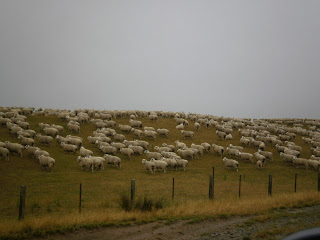
The sheep enterprise sells around four to five thousand lambs a week and aim to get them all out by March to focus on getting the ewe hoggets up to weight to go to ram and to get good grass for the ewes pre tupping. All the ewe hoggets go to the ram and they don't keep anything that doesn't go to the ram. They put 10,000 hoggets to the ram with an aim of 80% conception rate.
At weaning lambs are split through the auto drafter four ways at weaning 33kg + are killed, 30-33kg go in one group to keep an eye on and weighed regularly to see when they will be ready, then the next group are 26-30kg and then the under 26kg group, the bottom two groups wont be given much attention for a little while. They will be weighed again 8 weeks after weaning. These are not EID tagged the shedder just does it according to weight. The lambs that went to the works at weaning this year had an average carcass weight of 17.5kg. After weaning they take them through to 44kg.
The 1,500 stud ewes are run slightly different to the station ewes. All ewes and lambs on the genetic unit are EID tagged at birth.  The priorities for selecting rams are survivability, reproduction, growth, meat, dag, parasite resistance/resiliance. If there are any bad mothers or other negative remarks given to them over lambing they are killed. Before weaning they take a sample weight and aim to get an average weight of 30kg at 85days weaning. DLWG are often up at 300g with the singles sometimes up nearer 400g. The rams are sold on farm and they mostly sell 300-400 rams a year. I asked about the clients focus and 90% focus on records. Many of them are now looking at the meat trait, growth and survival with some looking at reproduction value and dags.
Animal health issues are slightly different down here to some of the farms I visited up north. Barbars pole worm or facial eczema is not a problem down here. However Nematodirus in lambs is an issues on the south island. This farm carries out regular fecal egg counts. On the stud they try to stretch out worming to cull tailenders. They would drench when about 10-20% are struggling when the rest are thriving. Every time they take a cull, weigh and look at figures per sire, number of culls per sire and weight per sire to see if they want to use that sire next year. They use 500 of the stud ram lambs on the station to assess them and check their condition after tupping. If they are in bad condition or are not happy with their performance they are not sold on as Rams.

Friday, 13 January 2012

Wellington

The first meeting I had in Wellington was with an organisation that has a number of focus farms working with EID technology. The aim of the seven year R&D programme is to make the industry more sustainable. There are currently 8 focus farms and 250 farms using the database (cattle, lambs and deer). They are planning on increasing the focus farms to 12. The focus farms are a cross section in terms of geography and farming type. The focus farmers are the drivers, making decisions what they would like to get out of the project and they get assistance on how to achieve it e.g. what information they need to record etc. Most farmers are recording weights and animal health, DLWG, groups of animals, forage and animal health. These farms host a couple of field days a year where they discuss financial issues and implications, animal health and agronomy. The focus farmers also meet a couple of times a year. The database holds information from the abattoir on individual lamb basis including Grade, x-ray weight, rib count, % hind, % middle, % fore. It was interesting to see how this varied. Other things they are looking at is taste, tenderness, aroma, colour, juiciness. It was interesting to see the taste panel results from a number of forages. On two crops the females were a lot worst than the males for taste. They were slightly better than males on some other crops. But not to the same extent.
The second meeting I had in Wellington we discussed the importance of agriculture in NZ and this is the reason why so much focus is on reducing green house gas emissions. There are some options but they are to expensive and not significant enough. The cost of them does not make practical sense. Their three main aims are to enhance productivity, reduce methane and nitrous oxide and explore international opportunities. Discussions revolved around similar topics covered in Palmerston North.  We discussed how the sheep decreased from 55 million in 1999 to 33 million with the same number of lambs produced so emission intensity has decreased in the sheep industry, however dairy cattle have increased from 3.5 million to 6 million, while beef cattle have stayed similar. Generally dairy are responsible for 40-45% emissions while beef and sheep are responsible for 55-60%.